
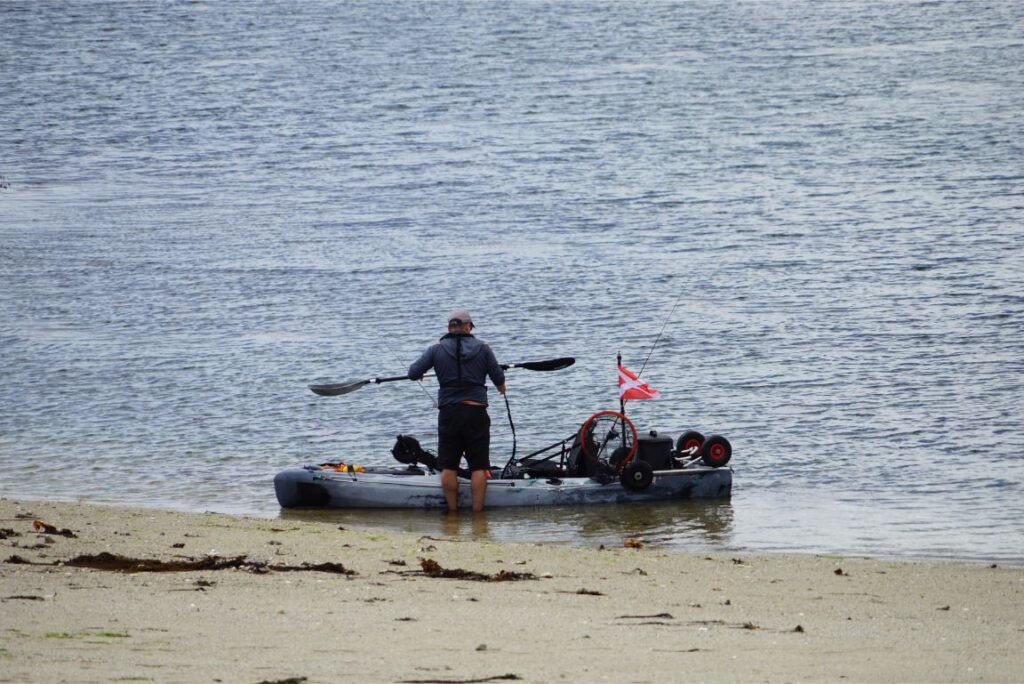
An anchor can make kayak fishing much easier when you need to hold on a productive spot.
It can keep you from drifting past a point, blowing away from a dock, or constantly correcting your position while trying to fish.
But an anchor is not something every beginner needs on day one.
Before adding one, learn how your kayak reacts to wind and current and become comfortable controlling the boat with your paddle or pedals.
If you are still learning the basics, start with our Kayak Fishing for Beginners guide. This article focuses specifically on anchor systems, positioning, and when anchoring makes sense.
What a Kayak Anchor Actually Does
A kayak anchor is mainly a boat-positioning tool.
It can help you remain near:
- offshore structure
- points
- grass edges
- productive holes
- docks
- rock piles
without continually paddling or pedaling.
Wired2Fish notes that shallow-water anchoring can make it much easier to thoroughly fish a productive spot without drifting away. :contentReference[oaicite:1]{index=1}
You Do Not Need an Anchor Everywhere
Many areas are easier to fish using:
- controlled drift
- short paddle corrections
- pedal propulsion
- a rudder
- shoreline protection
Anchoring should solve a real positioning problem.
It should not be added simply because another kayak angler has one.
When an Anchor Is Most Useful
Anchors are most useful when you need to remain in one small area long enough to fish it thoroughly.
Fishing Offshore Structure
If you locate a productive:
- rock pile
- drop-off
- submerged point
- brush pile
an anchor can keep the kayak from drifting away while you work different casting angles.
Fishing a Windy Shoreline
Moderate wind may continually push the kayak past cover.
You can often manage this with controlled drifts, as explained in our Kayak Fishing in Wind guide.
But if you need to remain on one precise target, anchoring may be more efficient.
Retie or Organize Gear
Holding position can also be useful when you need to:
- retie a lure
- change tackle
- adjust electronics
- handle a fish
without drifting into shore or away from the area.
Types of Fishing Kayak Anchors
There is no single anchor system that works best everywhere.
The right option depends mainly on:
- depth
- bottom type
- wind
- current
- kayak design
Small Folding Anchor
A compact folding anchor is a common kayak option.
It is easy to store and can work on a variety of bottoms.
Its effectiveness depends on the bottom and conditions, so simply buying a heavier anchor does not guarantee better holding.
Shallow-Water Anchor Pole
In shallow water, a stake-out or shallow-water anchor pole can be simpler than a traditional anchor.
The pole is pushed into a suitable bottom to hold the kayak in place.
This can work well around:
- flats
- shallow grass
- protected coves
- shoreline cover
Wired2Fish notes that shallow-water anchoring systems can make kayak boat control much easier when thoroughly fishing productive spots. :contentReference[oaicite:2]{index=2}
Powered Shallow-Water Anchor
Some fishing kayaks support powered shallow-water anchoring systems.
These can be convenient but add:
- weight
- cost
- mounting hardware
- battery requirements
They make more sense for anglers who regularly fish shallow water than for someone still learning kayak fishing.
What Is an Anchor Trolley?
An anchor trolley is a line system running along the side of the kayak.
It allows you to move the effective anchor attachment point toward the bow or stern.
Wired2Fish specifically notes that a trolley can improve your position for casting while anchored. :contentReference[oaicite:3]{index=3}
Why the Attachment Point Matters
Where the anchor pulls from affects how the kayak faces wind or current.
For example, moving the attachment point toward one end can help the kayak align more naturally with the forces acting on it.
That can create a better casting angle than simply clipping the anchor to a fixed point beside the seat.
An Anchor Trolley Is Not Mandatory
You can fish without one.
It becomes useful once you regularly anchor and find yourself needing better control over the kayak’s orientation.
Do not add extra rigging until you understand why you need it.
Where Should the Anchor Pull From?
A kayak is narrow and relatively easy to rotate.
Anchoring from an awkward point can create poor positioning and potentially increase instability.
Avoid Casual Sideways Loading
Do not assume that clipping an anchor beside your seat is automatically the best solution.
A strong sideways load can make the kayak behave differently than a pull aligned closer to the bow or stern.
This becomes especially important in moving water.
Use the Kayak Manufacturer’s Mounting Points
If your kayak includes:
- factory anchor points
- track-mounted accessories
- pre-tapped mounting locations
use those solutions where appropriate.
Wired2Fish notes that factory mounting locations can make shallow-water anchor installation simpler and avoid unnecessary modification of the hull. :contentReference[oaicite:4]{index=4}
How Much Anchor Line Do You Need?
The amount of line depends on:
- water depth
- wind
- current
- anchor design
- bottom type
A common mistake is dropping the anchor straight beneath the kayak and expecting it to hold effectively.
Many traditional anchors hold better when the line pulls at a lower angle rather than vertically.
Do Not Carry Excess Loose Rope
A small kayak does not have much free space.
Keep anchor line:
- organized
- contained
- away from your feet
- away from hooks and pedal systems
Loose line can quickly become a mess inside the cockpit.
How to Anchor in Calm Water
Calm lakes and ponds are the easiest places to learn how your anchor system behaves.
Step 1: Position Upwind of the Target
Move slightly beyond or upwind of the place you want to fish.
Remember that the kayak may continue drifting while you deploy the anchor.
Step 2: Lower the Anchor
Lower rather than throw the anchor when possible.
This gives you more control and reduces unnecessary tangling.
Step 3: Let Out Enough Line
Allow the anchor to reach the bottom and provide enough line for it to hold effectively.
Step 4: Allow the Kayak to Settle
The kayak may drift a short distance before the anchor holds.
Wait until the boat settles before beginning to fish.
Step 5: Check Your Casting Angle
If the kayak is facing the wrong direction, an anchor trolley or repositioning may improve the angle.
How to Retrieve a Kayak Anchor
Retrieving the anchor should be controlled and organized.
Reel or Gather Line Carefully
Keep the line from piling around your feet.
Store it immediately in its normal location.
Do Not Lean Aggressively Over the Side
Bring the anchor toward the kayak without shifting excessive body weight away from the centerline.
Be Ready for the Kayak to Move
As soon as the anchor releases, wind or current may begin moving the boat again.
Keep the paddle accessible.
This is one reason our How to Rig a Fishing Kayak guide recommends keeping boat-control equipment within easy reach.
Anchoring in Wind
Wind is one of the most common reasons kayak anglers consider an anchor.
But sometimes anchoring is unnecessary.
Try a Controlled Drift First
If the breeze is moving you along productive water at a useful pace, let it.
A drift can help you cover:
- shorelines
- grass edges
- flats
without repeatedly deploying and retrieving an anchor.
Anchor When Precision Matters
An anchor becomes more useful when you need to stay on:
- one point
- a small brush pile
- a specific depth transition
- a productive dock
for multiple casts.
Anchoring in Current Requires More Caution
Moving water changes the risk significantly.
Current can place continuous force on both the kayak and anchor system.
This is not the place to experiment casually with an unfamiliar anchor setup.
Do Not Learn Anchoring in Strong Current
Practice first in calm water.
Learn how to:
- deploy the anchor
- release it
- manage the line
- control the kayak
before attempting moving-water anchoring.
Know What Is Downstream
Before anchoring in any current, look for:
- fallen trees
- bridge pilings
- rocks
- rapids
- other obstructions
If the anchor releases unexpectedly, the kayak will immediately begin moving downstream.
Keep Safety Above Fishing
Current that exceeds your paddling and self-rescue ability is not made safer by adding an anchor.
Our Kayak Fishing Safety guide covers current, weather, cold-water exposure, and trip planning in more detail.
Anchor vs Drift
One of the most useful kayak skills is knowing when not to anchor.
Use a Drift When:
- you want to cover water
- wind speed is manageable
- you are fishing moving baits
- the shoreline has many targets
Use an Anchor When:
- you have located a small productive area
- you need repeated casts from one angle
- wind keeps pushing you away
- you need both hands free temporarily
Neither method is universally better.
Anchor vs Pedal Positioning
Pedal kayaks can sometimes hold position without anchoring.
Gentle forward or reverse pedaling can help you remain near:
- docks
- grass edges
- points
- offshore structure
This is especially useful when you expect to move frequently.
When the Anchor Is Easier
If you intend to stay in one place for an extended period, anchoring may require less effort.
When Pedals Are Easier
If you are constantly moving between targets, repeatedly deploying an anchor may slow you down.
Use the simplest positioning method for the type of fishing you are doing.
Shallow-Water Anchoring for Bass
Shallow bass fishing is one of the strongest cases for simple kayak anchoring.
A shallow-water pole can hold the kayak while you thoroughly work:
- grass pockets
- docks
- laydowns
- spawning flats where fishing is legal
- shoreline cover
This can be particularly useful when you find one productive piece of cover and do not want wind to move you past it.
Our Kayak Bass Fishing guide explains how positioning affects casting angles around these types of bass habitat.
Do You Need a Heavy Anchor?
Not necessarily.
Heavier equipment adds weight to the kayak and can become awkward to store and retrieve.
The correct anchor depends on:
- kayak size
- bottom type
- conditions
- anchor design
A small anchor that properly engages the bottom can be more useful than simply carrying excessive weight.
Consider Total Kayak Load
The anchor becomes part of the kayak’s overall load along with:
- angler
- rods
- tackle
- electronics
- battery
- cooler
- other equipment
Follow the kayak manufacturer’s capacity guidance.
Where to Store the Anchor
Store the anchor where it is secure but accessible.
A useful location should not interfere with:
- paddle strokes
- pedals
- casting
- standing
- landing fish
Keep the Line Contained
Use an organized line-management system rather than leaving loose rope across the deck.
Keep Heavy Gear Low
An anchor is relatively dense.
Keeping heavy equipment low generally helps avoid unnecessary changes to the kayak’s balance.
Common Kayak Anchoring Mistakes
Buying an Anchor Before Learning Boat Control
Learn to paddle and position the kayak first.
Anchoring Every Time You Stop
Many situations are easier to fish with a controlled drift.
Leaving Loose Anchor Line in the Cockpit
Keep rope organized and away from your feet and fishing hooks.
Using an Awkward Attachment Point
Think about how the anchor pull changes the kayak’s orientation.
Ignoring Wind or Current
Conditions determine how the kayak behaves once anchored.
Learning in Strong Current
Practice in calm, protected water first.
Putting the Paddle Out of Reach
The kayak may begin moving immediately when the anchor releases.
Adding Too Much Weight
Bigger and heavier is not automatically safer or more effective.
A Simple Beginner Anchoring Setup
If you decide you actually need an anchor, start simple.
A basic system may include:
- appropriate compact anchor
- organized anchor line
- secure attachment system
- optional trolley once you understand positioning
Practice deployment and retrieval on a calm pond before relying on it during a fishing trip.
Frequently Asked Questions
Do I need an anchor for kayak fishing?
No. Many kayak anglers use paddles, pedals, rudders, or controlled drift to maintain position. An anchor becomes useful when you need to stay on one precise spot.
What is the best anchor for a fishing kayak?
There is no universal best option. The right anchor depends on depth, bottom type, kayak design, wind, and whether you fish shallow or deeper water.
What is an anchor trolley?
An anchor trolley lets you move the effective anchor attachment point along the kayak, helping control how the boat sits relative to wind or current.
Is an anchor trolley necessary?
No. It becomes useful when you anchor regularly and want more control over the kayak’s orientation.
Can I anchor a fishing kayak in a river?
Anchoring in current requires substantially more caution than anchoring in calm water. Do not experiment in strong current, and learn your system in controlled conditions first.
Is a shallow-water anchor better than a traditional anchor?
It can be better in shallow water with a suitable bottom. Traditional anchors remain more versatile when the water is too deep for a stake-style system.
Should I anchor or drift when kayak fishing?
Drift when you want to cover water. Anchor when you need to thoroughly fish one small location.
Can a pedal kayak hold position without an anchor?
Often, yes. Pedal propulsion can make small continuous positioning corrections easier, especially in moderate wind.
Final Thoughts
An anchor is useful when it solves a specific kayak-fishing problem.
It can help you stay on a productive point, hold beside a grass edge, or thoroughly fish a piece of offshore structure without constantly correcting the boat.
But it is not a replacement for boat-control skills.
Learn how your kayak drifts first.
Keep the paddle accessible.
Understand how wind and current move the boat.
Then add an anchor when you know exactly what you want it to accomplish.
In calm or shallow water, anchoring can make kayak fishing much more efficient.
In moving water, treat it with much greater caution.
The best anchor setup is not the most complicated one. It is the one that holds your kayak where you need it without creating unnecessary clutter, weight, or risk.