
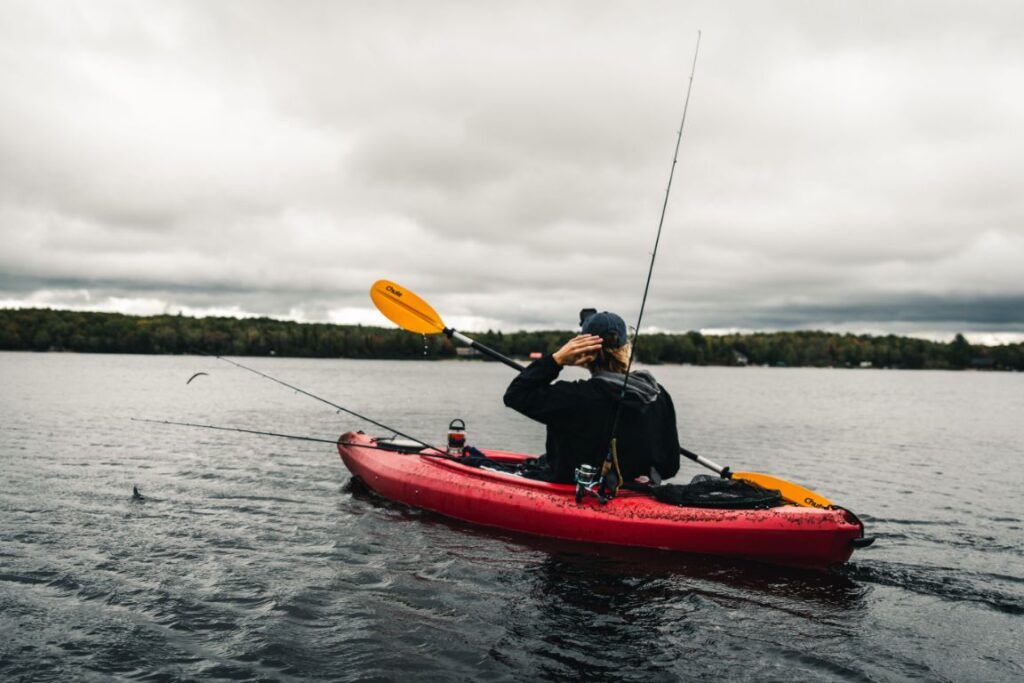
Fishing from a kayak changes the way you approach water.
You sit much lower than you would in a traditional boat, move quietly, and can reach shallow places that larger boats may not enter.
But there is a trade-off.
Every cast is affected by the kayak itself.
Wind can move you.
Current can rotate you.
A lure with enough resistance can even pull the bow slightly during the retrieve.
That means successful kayak fishing is not only about choosing the right lure.
You also have to learn how to put the kayak in the right position and keep it there long enough to make an effective presentation.
If you are completely new to kayaking, start with our Kayak Fishing for Beginners guide. This article focuses specifically on the fishing side: positioning, casting, drifting, working cover, and landing fish from the kayak.
Boat Position Comes Before the Cast
A common beginner mistake is paddling directly to the place you want to cast from.
By the time you put the paddle down and pick up the rod, the kayak is already moving past it.
Kayaks carry momentum.
Wind and current continue moving them even after you stop paddling.
Wired2Fish recommends stopping your paddle stroke before reaching your intended casting position and allowing the remaining drift to carry the kayak into place.
That small habit makes a major difference.
Start Slowing Down Early
Imagine you want to cast to a dock.
Instead of paddling until you are directly beside it:
- identify the casting angle you want
- stop paddling before reaching that point
- let the kayak glide
- make a small correction if necessary
- cast before you drift too close
The better you become at judging momentum, the fewer corrections you need.
That also means less noise around the fish.
Approach Fish Quietly
One of a kayak’s biggest advantages is stealth.
Do not waste it by making unnecessary noise.
Avoid:
- banging the paddle against the hull
- dropping pliers
- sliding tackle boxes around
- paddling hard at the target
- repeatedly correcting position at the last second
Slow down before entering productive water.
A quiet approach is especially useful around:
- shallow bass
- clear water
- docks
- grass edges
- small creeks
- spawning areas where fishing is permitted
Think About the Cast Before Moving the Kayak
Before paddling toward a piece of cover, decide:
Where do I want the lure to travel?
The best kayak position is not necessarily the closest position.
You may want to cast:
- parallel to a dock
- along a grass edge
- past a laydown
- across a point
- through a current seam
Position the kayak around the presentation rather than simply paddling toward the object.
Use Casting Angles to Your Advantage
A kayak can approach cover from many directions.
That gives you casting opportunities shore anglers may not have.
For example, a dock can be fished from:
- the outside edge
- the shaded side
- underneath the walkway
- deep water toward shallow water
- shallow water toward deeper water
Changing the angle can make the same lure behave completely differently.
Fish Parallel to Cover
Long parallel casts are particularly effective from a kayak.
If bass are using a grass edge, shoreline, riprap bank, or dock line, position the kayak so your lure stays near that cover for most of the retrieve.
A perpendicular cast may spend only a few feet in the productive zone.
A parallel cast can stay there much longer.
Use the Kayak’s Low Casting Angle
Kayak anglers sit close to the surface.
That low position can be useful.
Wired2Fish notes that the low angle makes it easier to skip soft plastics underneath docks and between branches.
It can also help with:
- low sidearm casts
- skipping soft plastics
- casting underneath overhanging vegetation
- reaching beneath docks
You do not always need to stand to gain an advantage.
Practice Sidearm Casting
A controlled sidearm cast is one of the most useful kayak casts.
It keeps the lure relatively low and can help you reach:
- under docks
- beneath tree limbs
- along shaded banks
Practice in open water first.
Smoothness is more important than power.
Do Not Over-Rotate During the Cast
Large, aggressive casting movements can shift your weight unnecessarily.
Keep your body reasonably centered.
Use:
- rod movement
- wrist control
- moderate torso rotation
rather than trying to generate maximum casting distance with your entire body.
Accuracy is usually more valuable than distance when kayak fishing around cover.
Casting While Seated Is Completely Effective
You do not need to stand.
Seated fishing provides:
- lower center of gravity
- good stability
- easier paddling transitions
- less fatigue
Standing offers advantages in some situations, but it should be optional rather than treated as a requirement.
When Standing Helps
If your kayak is designed for standing and you have practiced safely, standing can improve:
- visibility
- pitching accuracy
- flipping
- sight fishing
- long casting
Wired2Fish also notes that standing can improve casting angles and visibility, but emphasizes practicing balance and getting comfortable with the kayak first.
If you are thinking more about staying upright than catching fish, sit back down.
Keep Your Paddle Ready
Even when you are actively fishing, you may need the paddle every few minutes.
Keep it where one hand can reach it.
A short correction may be enough to:
- turn the bow
- move away from the bank
- avoid a stump
- adjust casting angle
- slow a drift
Do not store the paddle under several rods or behind equipment.
Learn One-Handed Corrections
Experienced kayak anglers often make quick corrections without completely stopping their fishing rhythm.
For example:
- hold the rod in one hand
- make one short paddle stroke with the other
- put the paddle back
- continue fishing
This becomes easier with practice.
Do not attempt complicated movements before you are comfortable controlling the kayak normally.
Understand Drift
Drift can be a problem or a tool.
Wind and current can move the kayak through productive water without you paddling.
Instead of constantly fighting the movement, ask:
Can this drift help me fish the area?
If the answer is yes, use it.
Wind-Drift a Shoreline
Suppose the wind is pushing parallel to a bank.
Position yourself upwind.
Then allow the kayak to move naturally while casting toward:
- shoreline cover
- grass
- docks
- wood
You can cover a large stretch of water with very little paddling.
When the drift ends, move back upwind and repeat if the area is productive.
Cast Ahead of Your Drift
If the kayak is drifting along a bank, do not wait until you are beside the target.
Cast slightly ahead.
The boat and lure then move through the area together.
This is particularly useful when fishing moving baits.
Use Wind Direction to Plan the Trip
Before launching, consider how wind will affect both:
- fishing
- the return trip
If possible, avoid spending the first several hours drifting effortlessly away from the launch only to face a difficult paddle back.
Our Kayak Fishing Safety guide covers weather and return-trip planning in more detail.
Fishing in Current
River kayak fishing requires more boat-control awareness.
Current may:
- rotate the kayak
- push you past targets quickly
- pull you toward obstacles
- change lure presentation
Instead of trying to stop the current completely, position yourself to use it.
Fish Current Seams
A current seam forms where faster and slower water meet.
Fish often use these transitions because they can remain in slower water while feeding on prey carried past them.
Approach from a safe angle and cast so your bait or lure travels naturally through the seam.
Do not become so focused on fishing that you drift toward downstream hazards.
Work Upstream When Appropriate
In moderate current, moving upstream first can make the return easier because you can travel back with the flow.
This is highly dependent on river conditions and your experience.
Strong current can quickly exceed a kayak angler’s ability.
Do not apply this idea blindly to unfamiliar rivers.
Paddle Kayak vs Pedal Kayak While Fishing
Both can be effective, but the fishing rhythm is different.
Paddle Kayak
You generally need to:
- put the rod down
- pick up the paddle
- reposition
- store the paddle
- resume fishing
This encourages anglers to plan positioning carefully.
Pedal Kayak
Pedal propulsion can make it easier to:
- hold position
- move slowly
- follow a depth contour
- correct drift while keeping the rod in hand
It is especially useful when wind is constantly moving the kayak.
Pedal Backward to Hold Position
Some pedal systems allow reverse movement.
That can be useful when wind or current pushes you toward a target.
Instead of continually turning and moving away, you may be able to pedal backward gently while continuing to fish.
Do not rely so heavily on propulsion that you ignore what the conditions are doing.
Fish the Water Closest to You First
Do not automatically cast as far as possible.
If productive cover is close to the kayak, fish it before moving deeper into the area.
Long casts can cause you to:
- cast over nearby fish
- create unnecessary line management
- lose accuracy
Short casts are often one of kayak fishing’s strengths.
Make Multiple Angles Around Good Cover
If a piece of cover looks particularly good, do not make one cast and leave.
Change your position slightly and try another angle.
For example, around a fallen tree you might cast:
- along the outside
- beside the trunk
- across the branches
- toward deeper water beyond it
Bass can hold on a surprisingly small part of a large object.
Kayak Fishing Around Grass
Kayaks are excellent around vegetation because they can move into relatively shallow water.
Fish:
- outside edges
- inside edges
- points
- holes
- isolated clumps
Position the kayak so your lure travels along the vegetation rather than constantly crossing it.
Fishing a Texas Rig From a Kayak
A Texas rig is particularly useful around shallow kayak-accessible cover because the protected hook can move through grass, wood, and brush with fewer snags.
Use the kayak to make short, accurate presentations around:
- grass openings
- laydowns
- docks
- stumps
Our Texas Rig Fishing Guide explains how to adjust weight, hook, and presentation for different cover.
Fishing Topwater From a Kayak
Topwater fishing can be especially enjoyable from a kayak because you are close to the action.
Position the boat far enough away that your lure can work through the productive area before reaching you.
Useful targets include:
- grass
- shallow points
- shade
- laydowns
Keep your paddle under control when a fish strikes.
Excitement is a common time to forget boat balance.
Fishing Moving Baits
Moving baits work well when you are drifting and covering water.
Examples include:
- spinnerbaits
- crankbaits
- swimbaits
- chatter-style baits
Cast ahead or across the direction of travel.
Try to keep the lure in productive water rather than simply retrieving it directly toward a moving kayak.
Retrieve Resistance Can Move the Kayak
A high-resistance lure may actually influence the kayak’s position.
Large crankbaits and other high-drag presentations can pull the bow.
Wired2Fish notes that lure resistance can even be used to help rotate or maneuver the kayak during the retrieve.
You do not need to deliberately use this technique as a beginner, but it explains why the kayak sometimes turns while retrieving certain lures.
Fishing Bottom-Contact Lures
When fishing:
- jigs
- Texas rigs
- finesse rigs
boat movement becomes especially important.
If wind pushes you rapidly toward the lure, you may create excessive slack.
If the kayak moves away, you may unintentionally drag the lure.
Watch both:
- the line
- the kayak
Sometimes the correct fishing adjustment is actually a boat-position adjustment.
Sensitivity Matters When the Kayak Moves
Low-stretch line can make subtle bites easier to detect, particularly when wind creates slack.
Braid and fluorocarbon each have useful characteristics.
Our Braided vs Fluorocarbon Fishing Line comparison explains how to choose between them based on cover and presentation.
Use the Rod to Control Slack
Boat movement constantly changes the distance between you and the lure.
Use the rod tip to:
- gather slack
- maintain contact
- give line when necessary
Do not automatically reel every time the kayak moves.
Watch what the lure is doing.
Fighting Fish From a Kayak
When a fish strikes, the kayak becomes part of the fight.
A strong fish may:
- turn the kayak
- pull it forward
- move you away from cover
This can actually work in your favor because the boat moves instead of the line taking all the pressure.
Let the Kayak Move
Do not panic if a good fish starts pulling the boat.
Maintain steady pressure.
Keep your balance.
Use the reel drag and rod.
Unless the fish is pulling you toward a hazard, the movement itself is not necessarily a problem.
Be Aware of Cover During the Fight
The situation changes quickly when a fish runs around:
- wood
- dock posts
- vegetation
- rocks
You may need to use your paddle or pedals to improve the angle.
This is easier if your deck is organized and paddle is accessible.
Landing a Fish
Decide how you intend to land the fish before it reaches the kayak.
Options depend on the species and situation:
- net
- hand landing
- appropriate fish grip
For larger or difficult-to-handle fish, a net can make the process much easier.
Keep the Net Reachable
Do not store your landing net where you need to turn completely around to retrieve it.
A practical position is usually:
- beside the seat
- immediately behind the seat
- beneath an accessible retention strap
Test the motion before the trip.
Bring the Fish Alongside the Kayak
Avoid lifting a large fish directly through the air from several feet away.
Bring it close.
Maintain control.
Then net or land it appropriately.
Keep your weight centered rather than leaning dramatically over the side.
Do Not High-Stick the Rod
When a fish is close to the kayak, avoid pulling the rod into an extreme vertical bend.
That can place excessive stress on the upper section.
Use the rod angle and reel to guide the fish close enough for landing.
Watch Loose Treble Hooks
A crankbait or topwater lure may have multiple exposed hooks.
When a fish reaches the kayak:
- stay organized
- keep the lure controlled
- use pliers when appropriate
A small deck and a thrashing fish create an easy opportunity for hooks to catch:
- clothing
- PFD
- seat
- gear
- you
After Landing the Fish
Before immediately celebrating, make sure the kayak is under control.
Wind or current may have moved you significantly during the fight.
Check your surroundings.
You may now be near:
- shore
- docks
- rocks
- another boat
- vegetation
Correct your position before spending unnecessary time handling the fish.
Keep Fish Handling Efficient
If you plan to release the fish:
- have tools ready
- minimize unnecessary handling
- keep the fish supported
- return it promptly
The exact handling method depends on species.
Do not search through a closed tackle box for pliers while a fish is lying on the deck.
Organize Gear Around the Fishing Process
Your setup should support this sequence:
cast → retrieve → hook fish → land fish → unhook fish → release or store appropriately
Frequently used items should be placed accordingly.
Our How to Rig a Fishing Kayak guide covers rod holders, crates, tackle organization, electronics, and weight distribution in detail.
Use Fewer Rods at First
One or two rods are plenty when learning how to fish from a kayak.
Too many rods can interfere with:
- casting
- paddle strokes
- landing fish
- branches
Bring versatile setups rather than trying to duplicate an entire bass boat.
Choose Techniques You Already Know
Your first kayak trip is not the ideal time to learn:
- a new boat
- a new reel
- a new fishing technique
- unfamiliar water
all at once.
Bring lures you already know how to use.
That frees your attention for boat control.
For bass anglers, our Bass Fishing Techniques for Beginners guide provides several simple techniques worth becoming comfortable with before taking them onto a kayak.
Stay Mobile
A kayak makes it easy to explore water slowly.
Do not spend the entire day in the first cove because launching took effort.
If an area is not producing, move.
Look for:
- different cover
- depth changes
- baitfish
- water clarity changes
- current
- wind-blown structure
Mobility is part of the kayak’s value.
But Do Not Paddle Past Fish
There is a difference between being mobile and constantly moving.
When you find:
- active fish
- productive cover
- a useful depth
- repeated bites
slow down.
Fish the pattern thoroughly.
Create a Repeatable Drift
If you catch fish during a particular drift, note:
- direction
- depth
- casting angle
- type of cover
- lure
Then return to the starting point and repeat it.
This is a simple way to determine whether the first fish was random or part of a pattern.
Use Landmarks
Without sophisticated electronics, shoreline landmarks can help you repeat productive positions.
Notice:
- trees
- docks
- houses
- points
- rock formations
Line up two landmarks when useful.
This can help you return to an underwater area that produced fish.
Do You Need a Fish Finder?
No.
For shallow cover fishing, visual clues may provide plenty of information.
A fish finder becomes more valuable when you need to identify:
- depth
- drop-offs
- submerged structure
- offshore fish
Learn visual boat positioning first.
Electronics should improve your fishing rather than distract you from learning the water.
Fishing Without an Anchor
Many areas can be fished effectively using:
- paddle corrections
- pedals
- wind drift
- current
- shoreline protection
You do not need to anchor every time you stop.
Learning to fish without one improves boat-control skills.
When an Anchor Helps
Anchoring can help when you need to stay on:
- a point
- offshore structure
- a productive hole
But anchoring introduces additional safety considerations, especially in current.
Read our Kayak Fishing Safety guide before adding an anchor system to moving-water fishing.
Common Kayak Fishing Mistakes
Paddling Too Close Before Casting
Stop early and let the kayak glide.
Ignoring Drift
The boat will continue moving while you fish.
Fighting the Wind Constantly
Use controlled drifts when conditions allow.
Bringing Too Much Tackle
Clutter makes boat control harder.
Casting Only One Angle
Use the kayak’s mobility to change presentation angles.
Standing Before You Are Ready
Seated fishing works perfectly well.
Putting the Paddle Out of Reach
Small positioning corrections happen constantly.
Watching Only the Lure
Keep track of where the kayak is drifting.
Leaning Too Far to Land a Fish
Bring the fish to you instead.
A Simple Practice Session
Before worrying about catching fish, spend 30 minutes practicing boat position.
Pick a harmless target such as:
- floating marker
- dock corner
- piece of shoreline
Practice:
- approaching quietly
- stopping early
- drifting into casting range
- making the cast
- correcting position
- making another cast from a different angle
This exercise teaches one of the most valuable kayak-fishing skills.
A Simple Fishing Sequence
Once you are comfortable, use this routine:
- identify promising cover
- choose your desired casting angle
- approach quietly
- stop paddling early
- let the kayak settle into position
- cast
- watch both the lure and kayak movement
- correct position when needed
- change angles before leaving
- move to the next target
Eventually this becomes automatic.
Frequently Asked Questions
Is fishing from a kayak difficult?
The fishing techniques themselves are familiar, but controlling the kayak while casting, retrieving, and fighting fish takes practice. Boat positioning is usually the biggest adjustment.
Should I fish sitting or standing?
Start seated. Standing can improve visibility and certain casting techniques, but it is not necessary for effective kayak fishing.
How do you keep a kayak still while fishing?
You can use short paddle or pedal corrections, position relative to wind and current, use an anchor where appropriate, or allow a controlled drift instead of remaining completely stationary.
How do you fish in wind from a kayak?
Position upwind of the area and use the wind to create controlled drifts when conditions are safe. Cast ahead of the drift and reposition when necessary.
How many fishing rods should I carry?
One or two rods are enough for beginners. Add more only after you understand how they fit into your kayak without creating clutter.
Is bass fishing good from a kayak?
Yes. Kayaks are particularly effective around shallow bass habitat such as grass, docks, laydowns, backwaters, and small ponds.
How do you land a big fish from a kayak?
Keep steady pressure, allow the kayak to move when safe, bring the fish alongside, and use an appropriate landing method such as a net. Avoid leaning excessively over one side.
Do I need a pedal kayak to fish effectively?
No. Paddle kayaks have been used successfully for fishing for years. Pedal propulsion mainly makes frequent positioning corrections easier while keeping your hands available.
Final Thoughts
The biggest difference between fishing from shore and fishing from a kayak is that your casting platform never completely stops being part of the presentation.
The kayak drifts.
It turns.
Wind moves it.
Current moves it.
Sometimes the fish moves it.
Instead of fighting those characteristics, learn to work with them.
Approach targets quietly.
Stop paddling before you reach your casting position.
Use the kayak to create better casting angles.
Let controlled wind drift help you cover water.
And keep the paddle close enough to make quick corrections.
Once boat positioning starts becoming automatic, fishing from a kayak feels much less like managing two separate activities.
The kayak simply becomes another fishing tool.