
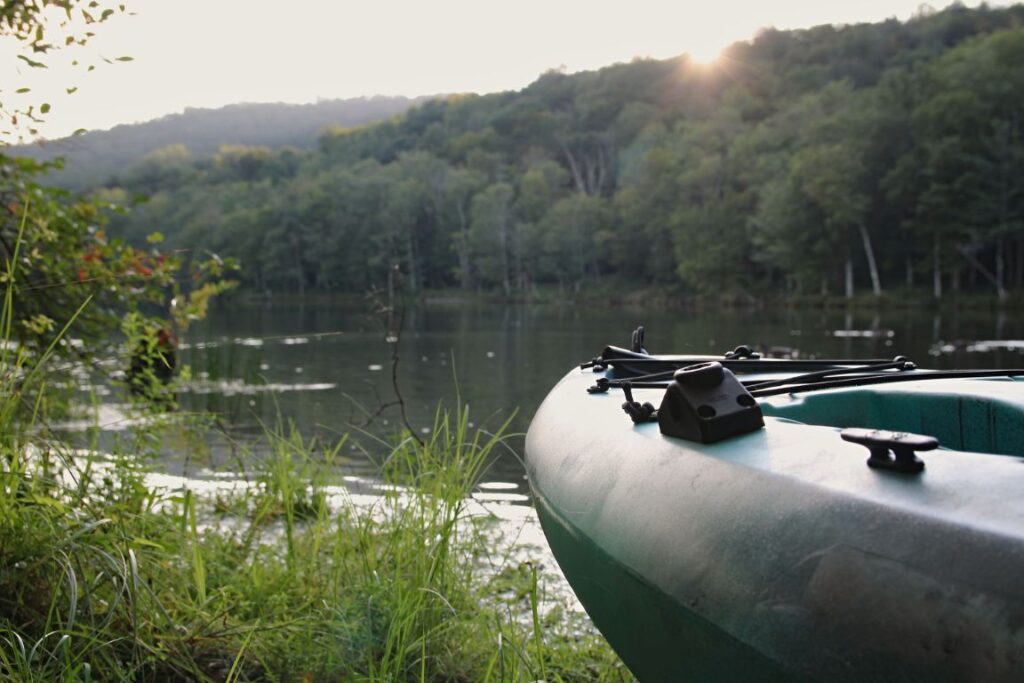
Kayaks and bass fishing fit together unusually well.
Bass often live around shallow grass, docks, laydowns, backwaters, small creeks, and other places that larger boats may struggle to reach. A kayak can quietly slide into those areas with very little disturbance.
That access is a major advantage, but success still depends on the same fundamentals that matter everywhere else: finding productive water, choosing a useful presentation, controlling your casting angle, and keeping the kayak positioned long enough to fish an area properly.
If kayak fishing itself is new to you, start with our Kayak Fishing for Beginners guide. If you are already comfortable controlling the boat, this guide focuses specifically on finding and catching bass.
Why Kayaks Work So Well for Bass Fishing
Kayaks can reach water that larger boats may have difficulty accessing, including narrow creeks, shallow flats, backwaters, heavily vegetated areas, and small ponds without conventional ramps.
That gives kayak anglers another advantage: some of these places receive less fishing pressure.
Stealth Is a Major Advantage
A kayak can be extremely quiet when used correctly.
Avoid:
- slamming tackle boxes
- striking the hull with your paddle
- making constant last-second corrections
- paddling hard directly into shallow cover
Slow down before reaching the area you intend to fish.
Start With Likely Bass Habitat
You do not need sophisticated electronics to find your first bass.
Look for:
- grass
- docks
- fallen trees
- stumps
- shade
- points
- creek channels
- riprap
- overhanging vegetation
- transitions between cover types
Bass use these areas for feeding, shade, ambush cover, depth access, or protection.
Fish the Closest Cover First
Do not automatically make the longest cast possible.
A kayak lets you make accurate short-range presentations.
Fish nearby cover before paddling deeper into the area.
That reduces the chance of moving over fish you could have caught.
Fishing Grass From a Kayak
Vegetation is one of the best places to use a kayak because shallow grass can be awkward for larger boats.
Break a grass bed into smaller targets rather than treating it as one large area.
Fish the Outside Grass Edge
The outer edge often forms a clear transition between vegetation and open water.
Bass can patrol that boundary.
Position the kayak parallel to the edge whenever practical so your lure stays near productive cover for more of the retrieve.
Fish Holes and Isolated Clumps
Small openings can be especially productive.
Cast into:
- holes
- pockets
- isolated clumps
- points in the vegetation
and let the bait fall before moving it away.
Use Texas Rigs Around Vegetation
A Texas rig is one of the most useful kayak bass presentations because the protected hook can move through vegetation with fewer snags.
Use short, accurate casts around grass openings and edges.
Our Texas Rig Fishing Guide covers hook choice, weight selection, rigging, and retrieves in more detail.
Fishing Docks and Wood
Docks, fallen trees, and other woody cover give bass shade, ambush points, and protection.
Kayaks can approach these areas quietly and from several useful angles.
Cast Parallel to Docks
A parallel cast keeps the lure near the dock edge longer than a quick perpendicular presentation.
Try:
- outside corners
- pilings
- shaded sides
- ladders
- walkways
- nearby depth changes
Skip Soft Plastics Under Docks
The low position of a kayak can make sidearm and skipping casts useful.
Good options include:
- stick baits
- compact Texas rigs
- small soft plastics
Practice the cast in open water before trying to place a lure beneath a dock.
Fish Laydowns From Several Angles
A large fallen tree deserves more than one cast.
Fish:
- outer branches
- trunk
- shaded side
- deepest end
- isolated limbs
Then reposition slightly and try another angle.
Do Not Paddle Into Cover Too Quickly
If you snag a lure or miss a cast, avoid immediately paddling into the best part of the cover.
You may still have fish available there.
Finish fishing the area before moving directly into it.
Fishing Creeks, Backwaters, and Points
Kayaks are particularly useful in small creeks and protected backwaters.
These areas often provide a mix of current, cover, bait, and shallow habitat.
Fish Current Breaks
In moving water, look behind:
- rocks
- wood
- bridge pilings
- points
where current slows.
Cast so your lure passes naturally through the transition.
Check Backwaters
Backwaters may hold:
- vegetation
- baitfish
- warmer water in cooler periods
- protected spawning habitat
Approach quietly because these areas can be shallow and clear.
Fish Points at Multiple Depths
A point gives bass access to both shallow and deeper water.
Fish:
- the top
- both sides
- the deeper end
Do not assume the visible shoreline tells you the whole shape.
Using Wind and Kayak Positioning
Wind can either ruin your presentation or help you cover water efficiently.
The difference is how you position the kayak.
Fish Wind-Blown Banks
Wind can push food and baitfish toward one shoreline.
That can make wind-blown banks productive.
Start upwind and let the kayak move through the area while casting toward:
- grass
- docks
- wood
- shoreline cover
Use Wind as a Fishing Tool
A controlled drift can be easier than constantly fighting the breeze.
When the productive section ends, reposition and repeat.
Do not use a drift if it carries you toward unsafe water, heavy traffic, or hazards.
Stop Paddling Before Reaching the Target
A kayak continues moving after you stop paddling.
If you paddle all the way to the exact casting position, you may drift past it.
Slow down early.
Let momentum carry you the final distance.
Then cast.
For more on positioning and drift, see How to Fish From a Kayak.
Best Bass Lures for Kayak Fishing
You can fish almost any bass lure from a kayak, but some are especially convenient because they cover common shallow-water situations without requiring a lot of tackle.
Soft Plastics
Soft plastics work especially well because they:
- require little storage
- can be rigged weedless
- work around shallow cover
- can be fished slowly
A few bags of plastics can cover a wide range of situations.
Spinnerbaits
Spinnerbaits are useful when:
- water is stained
- wind is creating surface disturbance
- bass are active
- you need to cover water
They work around grass, wood, and docks.
Bladed Jigs
Bladed jigs are effective around shallow vegetation.
Cast along grass edges, openings, and flats.
Change retrieve speed until you begin contacting fish or cover consistently.
Crankbaits
Crankbaits work well around:
- rock
- points
- riprap
- deeper flats
Keep in mind that a high-resistance lure can slightly pull or rotate a lightweight kayak during the retrieve.
Topwater Lures
Topwater presentations are especially useful around:
- grass
- shallow points
- shade
- laydowns
- calm pockets
Braid is commonly used for frogs around heavy vegetation.
See our Braided vs Fluorocarbon Fishing Line guide for a deeper line comparison.
Finesse Presentations
Good finesse options include:
- Ned-style rigs
- drop shots
- small worms
- small swimbaits
Braid with a fluorocarbon leader is a versatile spinning setup for many of these techniques.
Our How to Choose Fishing Line guide explains when that combination makes sense.
Tackle and Line Setup
A kayak rewards efficient tackle selection.
Do not try to reproduce the storage capacity of a full-size bass boat.
Keep Tackle Selection Small
Choose lures based on:
- season
- water clarity
- cover
- depth
- weather
Bring what you realistically expect to use.
Start With Two Rods
Two versatile setups can cover most beginner kayak bass fishing.
One useful combination is:
- medium-heavy rod for Texas rigs, jigs, spinnerbaits, and heavier soft plastics
- medium spinning rod for finesse worms, small swimbaits, and lighter presentations
Match the Line to the Cover
Use braid around thick vegetation.
Use fluorocarbon for many subsurface presentations around rock, wood, and clear water.
Use braid-to-fluorocarbon for finesse spinning setups.
Our Bass Fishing Techniques for Beginners guide provides more context for matching tackle to technique.
Finding a Bass Pattern
Once you begin catching fish, the next goal is to understand why.
Fish Good Water Thoroughly
When you find productive habitat, change:
- casting angle
- lure
- retrieve speed
- depth
before leaving.
Know When to Move
Thorough fishing does not mean staying in one place indefinitely.
If several good targets produce nothing, move and search for another pattern.
Look for Repeated Clues
Notice:
- depth
- cover
- lure
- retrieve
- water clarity
- wind
- shade
If several bass come from isolated grass near deeper water, start searching for more places with the same combination.
Repeat Productive Drifts
If a wind drift produces multiple bites, return to the starting point and repeat:
- direction
- distance from shore
- casting angle
- lure
That helps determine whether the first catch was random or part of a real pattern.
Pay Attention to Shade
Shade around:
- docks
- overhanging trees
- bridges
- steep banks
can be especially productive during bright conditions.
Kayak Bass Fishing by Season
Bass behavior changes through the year, but the kayak can remain useful in every season.
Spring
Bass often move shallower as conditions warm.
Kayaks can reach:
- protected coves
- shallow flats
- backwaters
particularly well.
Always follow seasonal and spawning regulations for the water you are fishing.
Summer
Useful areas may include:
- vegetation
- shade
- current
- deeper structure
- early and late shallow feeding zones
Carry enough water and account for heat.
Fall
Baitfish movement often becomes important.
Moving baits such as:
- spinnerbaits
- crankbaits
- swimbaits
- bladed jigs
can help you locate feeding fish.
Winter
Cold conditions may require:
- slower presentations
- deeper water
- more careful lure control
Cold-water kayak safety also becomes much more important.
Review Kayak Fishing Safety before treating winter fishing as just another seasonal pattern.
Paddle vs Pedal Kayaks for Bass
Both can be effective.
The better choice depends on your water, transport needs, and fishing style.
Paddle Kayaks
Useful for:
- shallow water
- simplicity
- lighter transport
- narrow creeks
Pedal Kayaks
Useful for:
- frequent positioning
- moderate wind
- holding the rod while moving
- covering larger water
When Pedal Systems Help Most
Pedal propulsion becomes especially useful when you need to:
- hold a casting angle
- correct drift
- follow a shoreline
- work offshore structure
- control the kayak while fighting fish
Do You Need a Fish Finder?
No.
A fish finder becomes more useful when fishing:
- deeper water
- offshore structure
- reservoirs
- unfamiliar lakes
Shallow kayak bass fishing can still be very productive using visible cover alone.
Do You Need an Anchor?
Not necessarily.
You can often control position using:
- paddle
- pedals
- controlled drift
Anchors become more useful on points or offshore structure but require additional caution, especially in current.
Fighting and Landing Bass
Once a fish is hooked, remember that the kayak itself may move.
That is normal.
Let the Kayak Move When It Is Safe
Maintain steady pressure and let the fish move the kayak if there is no immediate hazard.
The boat’s movement can actually reduce strain on the line.
Keep Fish Away From Cover
If a bass heads toward:
- wood
- dock posts
- heavy grass
you may need to adjust the kayak to improve the angle.
Keep your paddle or pedal system accessible.
Net vs Hand Landing
Many bass can be hand-landed safely.
A net becomes more useful when:
- the fish is large
- treble hooks are involved
- conditions are rough
- you want more control
Store the net where you can reach it easily.
Be Careful With Treble Hooks
Crankbaits and topwater lures may have several exposed hooks.
Inside a small kayak, those hooks can catch:
- clothing
- PFD
- seat
- gear
- your hands
Keep pliers accessible and control the fish before removing hooks.
Kayak Bass Fishing by Water Type
Different waters reward different approaches.
Small Ponds
Small ponds are one of the easiest places to begin.
Fish:
- shoreline cover
- vegetation
- corners
- drains
- points
- depth transitions
Keep the setup simple.
Reservoirs
Reservoirs may require more searching.
Look for:
- creek arms
- coves
- points
- riprap
- vegetation
- docks
- channels
Because distances can be greater, trip planning matters more.
Rivers
River bass may relate strongly to current.
Look for:
- current seams
- eddies
- wood
- deeper pools
- rock
- tributaries
Always give current safety priority over fishing.
Largemouth Bass
Largemouth often relate strongly to:
- grass
- wood
- docks
- shallow cover
Kayaks are particularly good at reaching this habitat quietly.
For broader bass fundamentals, see How to Catch Bass.
Smallmouth Bass
Smallmouth fishing often involves:
- rock
- current
- points
- deeper structure
- clear water
Our Smallmouth vs Largemouth Bass guide explains the differences in habitat and fishing approach.
Common Kayak Bass Fishing Mistakes
Bringing Too Much Gear
A kayak rewards simplicity.
Paddling Directly Onto the Fish
Stop early and glide into position.
Fishing Every Target From the Same Angle
Use kayak mobility to change the presentation.
Ignoring Wind
Wind changes both boat position and lure control.
Casting Too Far All the Time
Some of your best opportunities may be close.
Staying in Unproductive Water Too Long
Search for a repeatable pattern.
Standing Before You Are Comfortable
Seated fishing is highly effective.
Losing Track of the Kayak During the Fight
The boat can drift significantly while you focus on a fish.
Ignoring Safety Because the Water Looks Small
Small water can still involve wind, cold water, lightning, and submerged hazards.
A Simple First Kayak Bass Fishing Plan
For your first focused bass trip:
- choose a small familiar lake or pond
- bring one or two rods
- select a few proven lures
- begin around visible cover
- fish the nearest targets first
- approach quietly
- make several casting angles
- note where bites happen
- search for more similar habitat
- leave enough time and energy to return safely
The goal is not to catch every fish in the lake.
It is to learn how bass location and kayak positioning work together.
Frequently Asked Questions
Is kayak fishing good for bass?
Yes. Kayaks provide quiet access to shallow grass, backwaters, creeks, docks, and other productive bass habitat that can be difficult to reach with larger boats.
What is the best bass lure for kayak fishing?
There is no single best lure. Texas rigs, spinnerbaits, jigs, crankbaits, topwaters, and finesse soft plastics can all work well.
How many rods should I bring?
One or two versatile rods are enough for beginners.
Do I need a pedal kayak?
No. Paddle kayaks are highly effective. Pedal systems mainly make frequent positioning adjustments easier while keeping your hands available.
Can I stand while bass fishing from a kayak?
Only if the kayak is designed for standing and you are comfortable doing so. Standing is useful but not required.
Is a fish finder necessary?
No. It is helpful for deeper or offshore fishing, but plenty of kayak bass fishing occurs around visible shallow cover.
What line should I use?
Use braid around heavy vegetation, fluorocarbon for many subsurface presentations, and braid-to-fluorocarbon for finesse spinning setups.
Where should beginners look for bass?
Start around obvious cover such as grass, docks, fallen trees, shade, points, and transitions between shallow and deeper water.
Final Thoughts
Kayak bass fishing works best when you use the kayak’s natural strengths rather than trying to imitate a full-size bass boat.
Get shallow.
Move quietly.
Fish places that receive fewer casts.
Position the kayak so your lure stays in productive water longer.
Carry enough tackle to adapt, but not enough to clutter the deck.
And once you catch a bass, pay attention to where it happened.
The real advantage of a kayak is not simply that it floats.
It lets you approach productive bass habitat quietly, from useful angles, and often in water other anglers cannot easily reach.
Combine that access with good bass-fishing fundamentals, and the kayak becomes a remarkably effective fishing platform.