
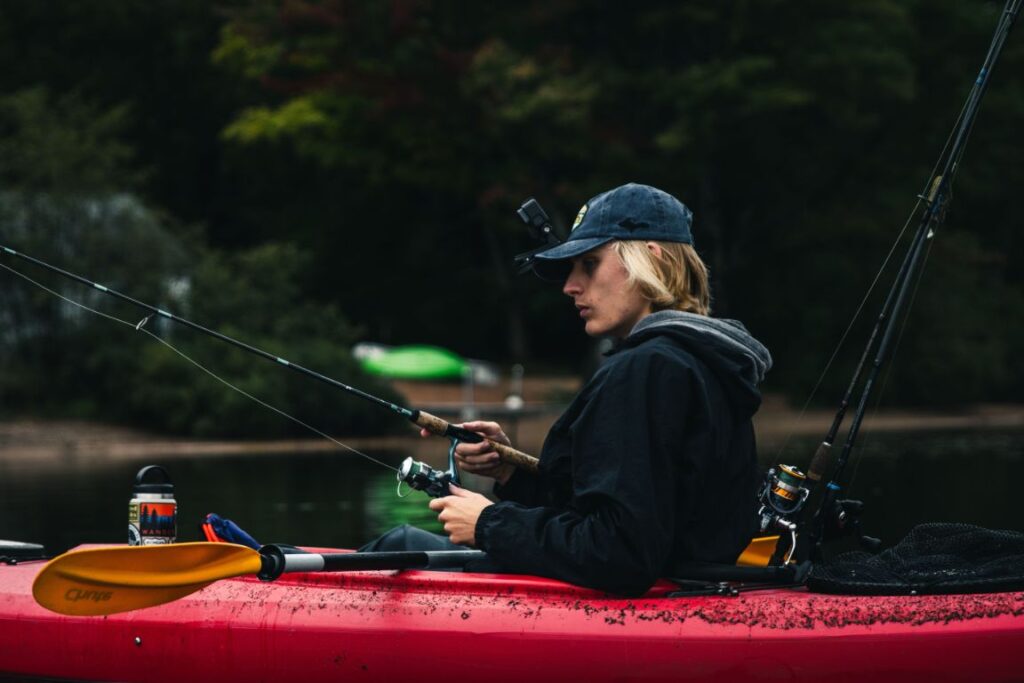
A kayak paddle may look like one of the simplest pieces of fishing equipment, but choosing the wrong one can make an otherwise comfortable fishing kayak frustrating to use.
A paddle that is too short may cause you to strike the sides of a wide fishing kayak. A paddle that is unnecessarily long can feel awkward and inefficient. A heavy paddle may seem fine for the first few minutes, but after hundreds of strokes the difference becomes obvious.
For kayak anglers, the right paddle depends mainly on:
- kayak width
- your height
- seat height
- paddling style
- blade shape
- shaft and blade materials
- how far you normally travel
You do not need the most expensive paddle available. You need one that fits your kayak and the way you fish.
If you are completely new to kayak fishing, start with our Kayak Fishing for Beginners guide. This article focuses specifically on choosing the paddle itself.
Why the Right Paddle Matters for Fishing
A kayak angler uses a paddle for more than simply traveling from the launch to a fishing spot.
You may use it to:
- move between fishing areas
- correct a wind drift
- turn toward cover
- back away from a dock
- hold a casting angle
- move through shallow water
- control the kayak while landing fish
Even anglers with pedal kayaks should normally carry a paddle as backup and for situations where the pedal drive cannot be used effectively.
That makes paddle fit and efficiency more important than they may initially appear.
A Poorly Sized Paddle Creates Extra Work
If the paddle is too short for a wide kayak or elevated seat, you may repeatedly hit the hull while trying to reach the water.
That creates unnecessary noise and forces you into awkward strokes.
A paddle that is much longer than necessary can also feel cumbersome during quick maneuvering.
How to Choose the Right Paddle Size
Paddle length should not be chosen from one measurement alone.
The most important factors are:
- kayak width
- paddler height
- seat height
- stroke style
Start With Kayak Width
Wider kayaks generally require longer paddles because the blade must reach farther out to enter the water efficiently.
This matters particularly for fishing kayaks because many are wider than traditional touring kayaks.
That extra width improves stability, but it also increases the distance between your seating position and the water.
Your Height Matters Too
Taller paddlers generally require slightly more paddle length than shorter paddlers using the same kayak.
Your height should therefore be considered together with kayak width rather than in isolation.
Seat Height Changes Your Reach
Many fishing kayaks use elevated or adjustable-frame seats.
Sitting higher above the water changes the stroke angle and increases the reach required to place the blade comfortably in the water.
If your kayak has both high and low seat positions, think about which position you actually use while paddling.
Do Not Choose by Height Alone
Two anglers of identical height may still need different paddle lengths.
One may be sitting low in a narrow kayak while the other is sitting high in a wide fishing kayak.
Use your height as part of the decision, not the entire decision.
Check the Manufacturer’s Sizing Chart
Once you know your kayak width, height, and seating position, check the paddle manufacturer’s own sizing recommendations.
Different paddle designs may use slightly different length guidance.
High-Angle vs Low-Angle Paddling
Your stroke style also affects the ideal paddle.
Low-Angle Stroke
With a low-angle stroke, the paddle shaft stays more horizontal and your upper hand remains relatively low.
This style is commonly associated with:
- relaxed paddling
- flat water
- longer distances
- lower cadence
Fishing kayakers covering large lakes may prefer this efficient style.
High-Angle Stroke
A high-angle stroke places the shaft more vertically.
The blade travels closer to the kayak and each stroke can provide stronger acceleration.
This can be useful when you need:
- quick maneuvering
- strong acceleration
- more aggressive boat control
High-angle paddling generally pairs with a somewhat shorter paddle and broader blade than relaxed low-angle paddling.
Choose a Paddle for the Water You Fish
The type of water you fish should influence your paddle choice.
Small Ponds and Protected Lakes
If most trips involve:
- short distances
- calm water
- frequent casting
you may value simple handling and durability more than minimum weight.
Large Lakes
If you regularly paddle significant distances, paddle weight and efficiency become more important.
A small weight difference repeated over thousands of strokes can become noticeable.
Rivers and Tight Creeks
Quick turning and maneuverability may matter more in narrow water.
You may frequently use:
- reverse strokes
- sweep strokes
- short corrections
Our How to Fish From a Kayak guide explains how these positioning adjustments affect actual fishing.
Paddle Weight and Materials
Paddle weight is easy to underestimate when shopping.
Hold two paddles in a store and the difference may seem small. After a full day on the water, it can feel much larger.
The more often and farther you paddle, the more useful a lighter paddle becomes.
Aluminum
Aluminum shafts are common on economical paddles.
Advantages include:
- affordability
- durability
- widespread availability
The drawbacks are extra weight and the fact that exposed aluminum can become uncomfortable in very hot or cold conditions.
Fiberglass
Fiberglass is often a practical middle ground.
It can reduce weight while remaining durable and usually costs less than premium carbon construction.
For many anglers who fish regularly, this is a sensible balance.
Carbon
Carbon-based paddles can be very light and stiff.
That reduces the amount of weight you lift on every stroke and transfers effort efficiently into the water.
The main disadvantage is price.
If you frequently paddle long distances, the reduced fatigue can become more valuable.
Choosing the Right Paddle Blade
The blade affects how much power you create and how tiring the paddle feels over time.
Narrower Blades
Longer, narrower blades are useful for:
- relaxed strokes
- long trips
- efficient sustained paddling
They often pair naturally with low-angle paddling.
Wider Blades
Broader blades can provide more immediate power.
They are useful for:
- quick acceleration
- strong turns
- maneuvering around cover
- moving water
The trade-off is that repeated powerful strokes may be more tiring.
Dihedral Blades
Many paddle blades use a slight central shape that helps guide water across both sides of the blade.
This can reduce flutter during the stroke and make the paddle feel more predictable.
You do not need to focus heavily on the terminology, but a stable blade is useful during long fishing days.
Shaft and Paddle Construction
Beyond material, several construction details can affect comfort and transport.
Straight vs Bent Shafts
Most fishing paddles use a straight shaft.
Bent shafts change hand position during part of the stroke and may feel more comfortable for some paddlers.
For most beginners, a straight shaft is perfectly adequate.
One-Piece, Two-Piece, or Four-Piece
Two-piece paddles are particularly practical for fishing because they are easy to transport and store.
Four-piece designs break down even smaller and can be useful for travel or portable-kayak setups.
One-piece paddles can be simple and stiff but are less convenient to transport.
Matched vs Feathered Blades
Matched blades sit on the same plane.
Feathered blades are offset from each other.
Feathering can reduce the amount of surface exposed to wind while the upper blade moves through the air.
Experiment with the available settings rather than assuming one angle is universally best.
Fishing-Specific Paddle Features
Some paddles include features designed specifically for anglers.
Hook Retrieval Notches
A small notch in the blade can sometimes help guide the paddle down the line to free a snagged lure.
This can be convenient, but it should not outweigh more important factors such as:
- correct length
- weight
- blade design
- durability
Measurement Markings
Some paddles include markings that can be used to estimate fish length.
Again, treat these as extras rather than primary buying criteria.
Basic Paddle Technique for Fishing
Even a perfectly sized paddle performs poorly if your stroke wastes energy.
How to Hold the Paddle
Keep your hands comfortably spaced along the shaft rather than crowded near the center or stretched excessively wide.
Use a relaxed grip rather than squeezing the shaft continuously.
Use Your Torso
Efficient paddling relies on torso rotation rather than pulling only with the arms.
Your larger torso muscles can provide sustainable power while reducing arm fatigue.
Forward Stroke
Plant the blade forward near your feet and draw it back toward your hip while rotating through the torso.
A clean stroke should move the kayak forward without excessive splashing.
Reverse Stroke
The reverse stroke helps you:
- slow down
- back away from cover
- correct your position
It is especially useful around docks and shoreline structure.
Sweep Stroke
A wide sweep helps turn the kayak efficiently.
It is often more effective than repeatedly making small forward strokes on one side.
Small Correction Strokes
These are some of the most useful strokes while actively fishing.
A single short stroke can change your casting angle without completely interrupting your fishing rhythm.
This becomes especially important in wind. Our Kayak Fishing in Wind guide covers controlled drift in more detail.
Choosing a Paddle for Different Fishing Kayak Setups
Different kayak designs create different paddle requirements.
Wide Fishing Kayaks
Wide fishing kayaks generally require more paddle reach.
If the paddle is too short, you may:
- strike the hull
- reach awkwardly
- use inefficient strokes
- create unnecessary noise
Elevated Fishing Seats
A raised seat moves you farther from the water.
That often increases the paddle length you need.
If your kayak has adjustable seating, choose based on the position you actually use while paddling.
Long-Distance Fishing
If you regularly travel several miles, prioritize:
- low weight
- comfortable shaft diameter
- efficient blade shape
- correct sizing
A paddle does not need to feel dramatically better during one stroke to save a meaningful amount of effort over an entire trip.
Tight Creeks
In confined water, maneuverability matters.
You may frequently need to:
- turn quickly
- back away
- avoid branches
- change casting angle
Do not automatically choose the longest paddle possible simply because your kayak is wide.
Pedal Kayaks
Pedal anglers should still carry a paddle.
A pedal drive may become unusable because of:
- very shallow water
- vegetation
- mechanical problems
- underwater obstacles
A paddle also provides better short-range maneuvering in some situations.
Store it somewhere accessible. Our How to Rig a Fishing Kayak guide covers paddle storage and overall gear placement.
How Much Should You Spend?
Spend according to how much you actually paddle.
Occasional Short Trips
A durable entry-level paddle may be completely sufficient.
Frequent Fishing
Moving to a lighter fiberglass-based paddle can reduce fatigue without the cost of premium carbon construction.
Long-Distance or Frequent Paddling
A lighter high-performance paddle becomes easier to justify because you benefit from the reduced weight on every stroke.
Do not pay primarily for fishing-specific extras while ignoring proper fit.
Common Kayak Paddle Buying Mistakes
Choosing by Price Alone
The cheapest paddle may work, but make sure the dimensions fit your kayak.
Ignoring Kayak Width
Fishing kayaks can be substantially wider than other kayak styles.
Ignoring Seat Height
An elevated seat changes your reach to the water.
Buying the Longest Paddle Available
Longer is not automatically better.
Focusing Only on Weight
A lightweight paddle with the wrong dimensions is still the wrong paddle.
Choosing Fishing Features Before Fit
A hook notch is convenient. Correct length is more important.
Never Testing the Paddle
If possible, try the paddle before buying or purchase from a retailer with a practical return policy.
A Simple Kayak Paddle Buying Checklist
- Measure your kayak width.
- Note your height.
- Consider whether the seat is elevated.
- Decide whether you mainly use a high- or low-angle stroke.
- Check the manufacturer’s sizing chart.
- Choose a blade style that matches how far and how aggressively you paddle.
- Choose the lightest construction that makes sense for your budget and usage.
- Confirm the paddle breaks down suitably for transport and storage.
This will get you much closer to the right paddle than choosing based only on appearance, price, or fishing-specific features.
Frequently Asked Questions
What size paddle do I need for a fishing kayak?
The correct size depends primarily on kayak width, your height, seat height, and paddling style. Wide fishing kayaks and elevated seats generally require more reach. Check the paddle manufacturer’s sizing chart for the final recommendation.
Why do fishing kayaks often need longer paddles?
Many fishing kayaks are wider and use higher seating positions than traditional recreational kayaks, increasing the distance between the paddler and the water.
Is a lightweight kayak paddle worth it?
It becomes increasingly valuable when you paddle frequently or cover longer distances because you lift the paddle hundreds or thousands of times during a trip.
Is fiberglass or carbon better for a kayak paddle?
Both can work very well. Fiberglass often provides a good balance of price, weight, and durability. Carbon can reduce weight further but costs more.
What blade shape is best for kayak fishing?
There is no universal best shape. Narrower blades are useful for efficient sustained paddling, while broader blades provide stronger acceleration and maneuvering.
Should kayak paddle blades be feathered?
Feathering can reduce wind resistance on the blade that is out of the water, but matched blades also work well. Use the setting that feels most comfortable and efficient for your stroke.
Do I need a fishing-specific kayak paddle?
No. Fishing-specific features can be convenient, but correct length, weight, blade design, durability, and comfort are more important.
Do I need a paddle with a pedal kayak?
Yes, carrying one provides backup propulsion and helps with maneuvering in shallow water, vegetation, and tight spaces.
Final Thoughts
The right fishing kayak paddle should feel like part of the boat rather than another piece of equipment you have to fight.
Start with the width of your kayak.
Add your height and seating position.
Then think about how and where you actually paddle.
If you spend hours covering open water, a lighter and more efficient paddle can reduce fatigue substantially.
If you mainly fish small ponds close to the launch, a durable economical paddle may be all you need.
Do not choose by price, length, or fishing features alone.
Choose a paddle that lets you reach the water comfortably, maneuver the kayak quietly, and still feel comfortable after hundreds of strokes.
That is what makes a paddle useful for fishing.